
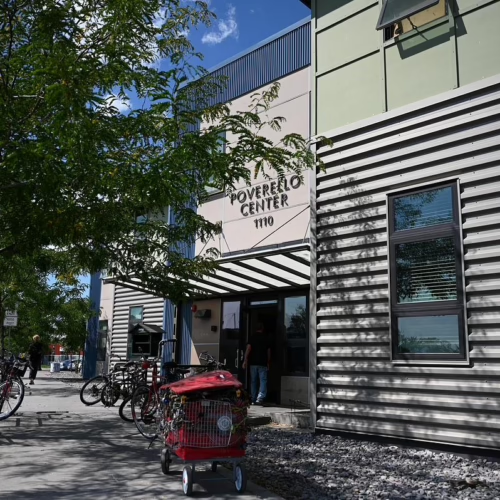
The closure of the 165-bed temporary shelter has left the Poverello Center at capacity and has strained other organizations serving people living on the street.
by Katie Fairbanks 09.15.2026
Missoula officials, homeless service providers and unhoused people all agree: When the Johnson Street temporary emergency homeless shelter closed one year ago, it was not because the need went away.
The last 12 months without the 165-bed emergency shelter have left Missoula’s longstanding homeless shelter full more often than not and have strained other organizations serving people living on the street. Limited shelter capacity also means more people are living outside to navigate the city’s camping restrictions, providers said.
“Over the last year, we’ve gotten really good at managing scarcity,” Jill Bonny, the Poverello Center’s executive director, told Montana Free Press. “Too few beds, too little housing, too few places for people to go. What I’d like to work on next is creating enough options to help people move forward instead of just moving them around.”
The Poverello Center opened the Johnson Street shelter in November 2020 and operated it as a 24-hour shelter for three winters. After a spike in Missoula’s unsheltered population, the shelter reopened in September 2023 and ran year-round for two years. The city and county used COVID-era federal funding to cover the cost, but that money ran out in 2025.
City officials announced in March 2025 the shelter’s closure, along with a “housing sprint” to get as many shelter residents as possible into permanent housing before Sept. 2, 2025. Over those five months, the shelter’s nightly capacity was gradually reduced from 165 beds in March to 30 in August.
As part of the housing sprint, 63 people secured permanent housing, including 58 who were staying at the Johnson Street shelter, according to the city. As of the end of February, six months after the sprint, 83% of participants had retained their housing, said Emily Armstrong, the city’s houseless programs manager.
Clayton Shaya, a member of the Unhoused Neighbors Union, told MTFP he secured housing during the sprint after getting a voucher and money for a rental deposit. But he knows other people who have since lost their housing and have fewer opportunities for getting help.
As part of the sprint, the city raised about $200,000 to pay for rental applications, deposits, rent, utility bills, other debts and moving costs. While the United Way of Missoula County’s housing solutions fund can also pay for those things, it is limited and often runs out of money.
“The means that were used during the sprint have left a poor expectation for unhoused folks trying to get housed at this point,” Shaya said.
Shaya also raised concerns about the switch from the sprint’s focus on housing willing participants back to the previous system that prioritizes resources for the most vulnerable.
Armstrong said while some people are very vulnerable and need to be prioritized for resources like permanent supportive housing, others just need a little financial help and guidance to get into stable housing.
“The system got good at prioritizing the most vulnerable, but when you’re doing that, paying the most attention to those people, hundreds of other people unhoused in our community are not getting the same attention,” she said. “It’s a challenging task to give the attention that every individual needs to everyone when resources and capacity are limited.”
Since the Johnson Street shelter closed, more people have been forced to stay outdoors and are “consistently and systematically moved,” Shaya said. There was a “flood” towards the Poverello Center after the closure and an increase in citations for violating the city’s rules against camping on city property, he said.
The number of citations issued last year increased as the city began phasing out the Johnson Street shelter, according to a report from the Missoula Municipal Court. Of the 161 citations issued from January through Dec. 15, 2025, most were for being too close to the river or too close to a shelter, according to the municipal court.
Since the Johnson Street shelter closed, the Poverello Center’s West Broadway shelter has been “pretty consistently full,” even during the summer, which is historically a less busy season, Bonny said. The shelter has 150 beds, but some are dedicated to specific programs or populations, like veterans and women. Bonny said that can mean turning someone away even when there is an empty bed.
“We just never had to turn people away due to capacity when we had the Johnson Street shelter,” she said. “Even when it was extremely cold or smoky or hot, whatever the weather was that would bring more people in, we never had to say no because of capacity. … [Now] we’ve had to tell people, ‘I’m sorry, but we don’t have a bed for you tonight,’ which can be really hard on people seeking shelter but also on our staff.”
Missoula’s annual Point in Time Count, a HUD-required survey of unhoused people on one night in January, recorded 180 unsheltered people, up from 128 last year. The count is widely considered to be an underestimation.
The closure has also strained the Poverello’s Homeless Outreach Team, which provides food, gear, support and connection to services for people living outdoors. Without the Johnson Street shelter as a service hub and a place where people could store their belongings, the team is providing more transportation to appointments and services, Bonny said.
“The HOT team has increasingly become the bridge between people living outside and the services system spread across the community,” she said.
Bonny said it’s challenging to stay connected to people living outside when they have to move frequently.
The city’s rules restricting camping on city property establish buffer zones where camping is not allowed, including in city parks. The rules also establish a vehicle parking permit system that allows someone living in their vehicle to remain parked in certain areas for up to 90 days before needing to move.
Those rules can be hard to understand and moving often adds to the exhaustion of people dealing with homelessness, disability and mental illness, Bonny said. While not every citation results in a fine, the accompanying court date is another obligation to manage on top of daily survival and the search for housing, she said.
“We understand that the city is trying to balance some very real concerns from neighbors, businesses and people living outdoors,” Bonny said. “From a service provider perspective, moving people frequently not only makes our job harder but makes it harder for people trying to exist day-to-day.”
Eran Pehan, the city’s Community Planning, Development and Innovation department director, told MTFP the goal of the ordinance was to help make living outdoors as safe as possible for unhoused individuals and for the broader community. The rules have been successful in ensuring camps stay small and do not become entrenched, she said.
Unsheltered homelessness is a broader structural, policy-based issue that the ordinance was not designed to solve, Pehan said. The city is addressing homelessness through several different avenues, she added.
Regarding concerns that the rules make it more difficult for people to access services, Pehan said the city is working to identify those individuals. Resources like the Watershed Navigation Center offer people a consistent space to connect to services no matter where they sleep at night, Pehan said.
The Watershed Navigation Center, run by Partnership Health Center, is located next to the Missoula County jail and helps connect unhoused people or those recently incarcerated to resources. The Watershed has seen a large increase in foot traffic since the Johnson Street shelter closed, said Chaz Rourke, the center’s operations manager.
“People are just needing a space to be,” Rourke said. “The Johnson Street shelter was more than a place to sleep at night. It was where people kept all their stuff, used the bathroom, accessed services.”
The Missoula Interfaith Collaborative’s Housing Advocate Network and Job Service Missoula, which helped housing sprint participants, now regularly visit the Watershed to help connect people to housing and jobs. The Watershed can process requests for the housing solutions fund to help people remove one or two barriers to housing, Rourke said.
Challenges remain in helping older people or those with disabilities who can’t work and have limited income from Social Security, Rourke said. While they may qualify for a housing voucher or placement in affordable housing, those things often take time, he said.
As numbers have increased, the Watershed is operating more as a day shelter than a navigation center, Rourke said. To provide more focused services, the Watershed is adjusting its hours this week to set aside time in the afternoons for group meetings and activities, he said.
“We can’t be a day shelter and navigation center at the same time,” Rourke said. ”We need both to help folks move through tough times.”
Day shelter services will be more limited starting next month when Hope Rescue Mission closes its drop-in center.
In June, the religious nonprofit announced its plans to “transition from a government-supported ministry to a donor-supported ministry” that included closing its drop-in center and ending its federally funded case management program Oct. 1. Hope Rescue Mission also did not renew its contract with Missoula County to operate the Temporary Safe Outdoor Space, a transitional housing program using pallet shelters on West Broadway.
Missoula County is working with community partners to find an organization to run the transitional housing program, said Anne Hughes, the county’s chief operating officer. It is also identifying funding to run the program, which was previously covered by COVID-era federal funds, she said.
Bonny with the Poverello Center said the closure of the day center at the Hope Rescue Mission will likely add stress to the shelter, the Watershed and the Missoula Public Library.
“Think of how snowshoes work,” Rourke said. “Dispersing weight across a large area helps any one point feel like it’s not going to break. That area keeps getting smaller.”
On top of that, Rourke said the Watershed and other homeless service providers are encountering more elderly people who can’t care for themselves. The organizations, he said, can’t properly address those needs.
Services such as a larger medical respite program and a crisis center would provide additional places for people who need care but not hospitalization, Rourke said.
Bonny echoed that sentiment, saying there’s also a need for more daytime services where people can access bathrooms, water and case management.
“Our staff are managing a very busy building with people with increasingly complex needs, needs really beyond what an emergency shelter would normally provide,” she said. “We’re just trying to do the best we can. We know if we say no to people, there’s not another option, and that can get really straining on staff.”
The community has gaps in behavioral health and substance use treatment and a need for more deeply affordable and supportive housing, Bonny said.
“Shelter is not the solution to homelessness, housing is,” she said.